Featured

Conservation Elective Group 3

With a rather unusual start to an elective, we began with the class being asked to sit in a circle. This prompted the wailing screeches of tables being moved out of the way for the UN style circle seating. Once seated (after quite some fuss over ellipses) we were introduced to the first task / game.

To check how alert and awake we truly were (we weren’t) – we had to place our index finger on the palm of the person next to us while they attempt to trap it – at a certain verbal cue. With round one yielding rather embarrassing results for us, (barely anyone got it) we focused ourselves over this game that we had just been introduced, mere minutes ago. This time people got the hang of it and began to pick up on the cue early – with the subsequent rounds having several trapped fingers held up in the air, marking the success.

The next task was a bit more challenging. We were split into 6 teams via random selection and were tasked with creating a model using regularized newspaper sheets, employing a 2 of our members to be part of the model itself. With the time limit of around 25 minutes, we were provided the first term to build our model around – Aesthetics. With 2 people engaged in building the model, and 2 people being the model – the remaining 2 were left to sketch, document and present it.

For this round, our Group decided to go for an approach of using small repeatable units made to look like pointy scales. The concept surrounding being the evolution of spiky natural forms. From hard scales on the back to dinosaurs to the pointed features in Nordic armory (inspired by mythical creatures like dragons) to now finally making its way into architecture via kinetic facades in parametric architecture. It nearly worked – but atleast we had good fun with team building exercise as a whole.

The next term was ‘Elements’ for which we used the idea of how structural systems are very elemental. With the most complex geometries and marvels of engineering – all being brought down to simple modular elements that are repeated over and over – supporting each other. Naturally we opted to depict this via human bridge of sorts, with the 2 models being pylon and newspaper bridge supported on them.

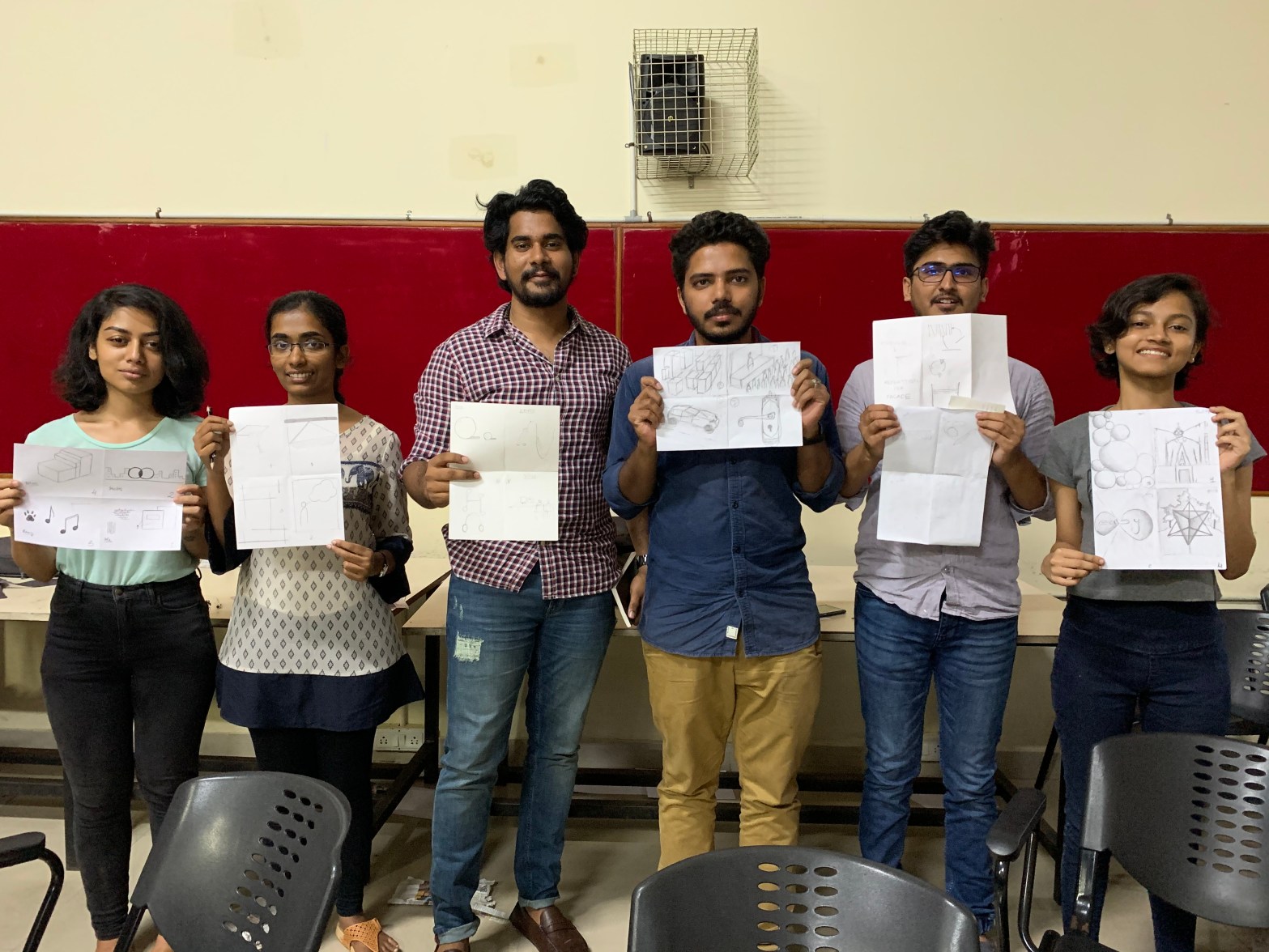
Following a short break – we were to quick sketch (individually) onto A4 sheet of paper, the things that pop into our heads when we hear the following words

  1. Mass
  2. Identity
  3. Ease
  4. Oneself

The following led people to gain a deeper understanding of themselves and allowed them to see patterns in their instincts. Created a new perspective among many on how to view oneself.
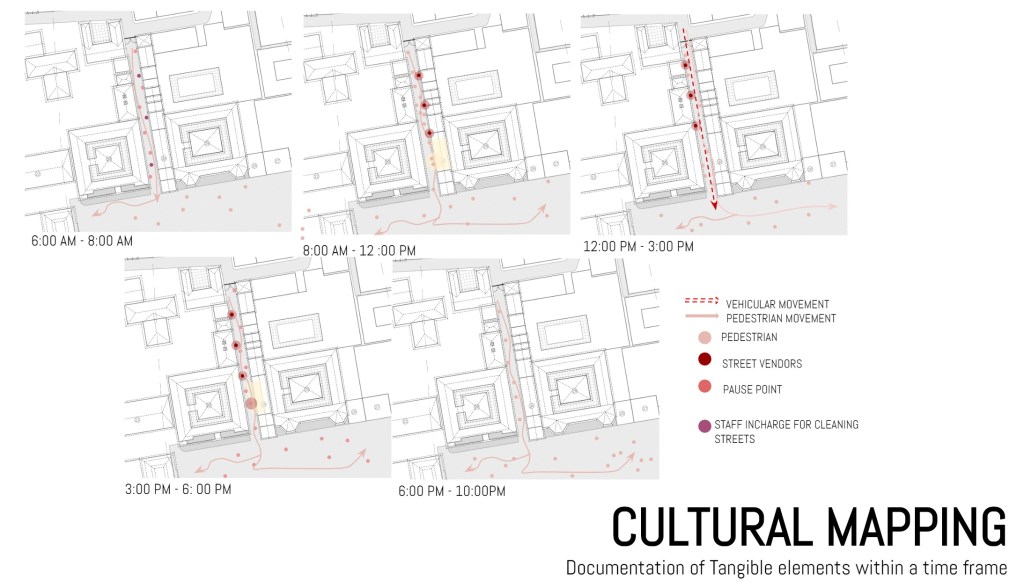
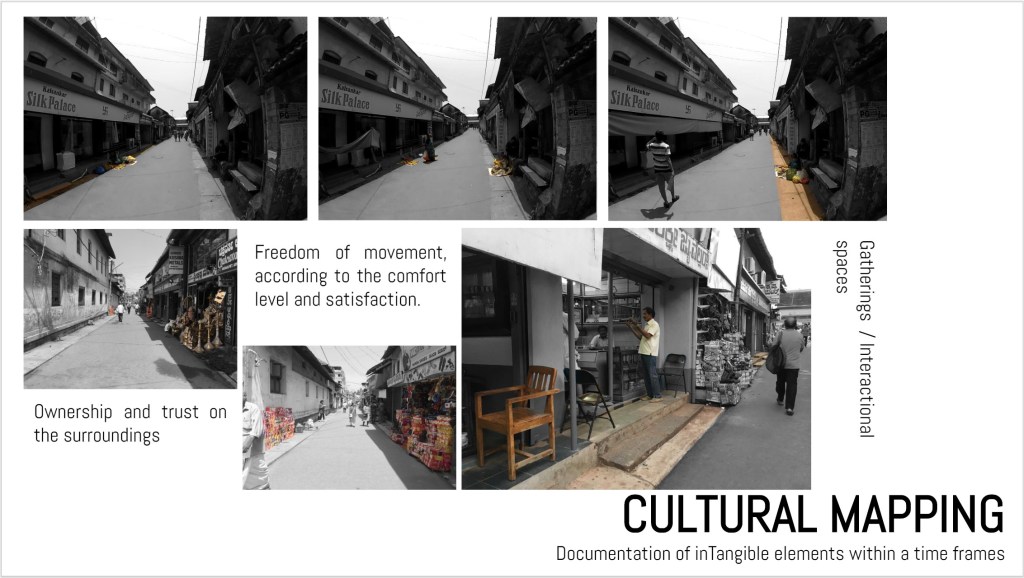
Udupi Streets Culture Mapping

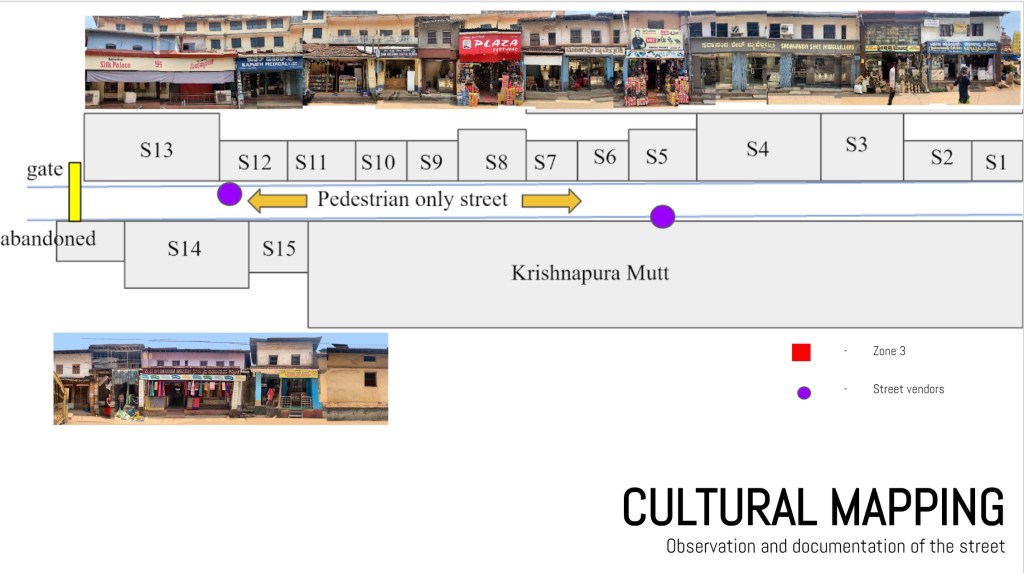
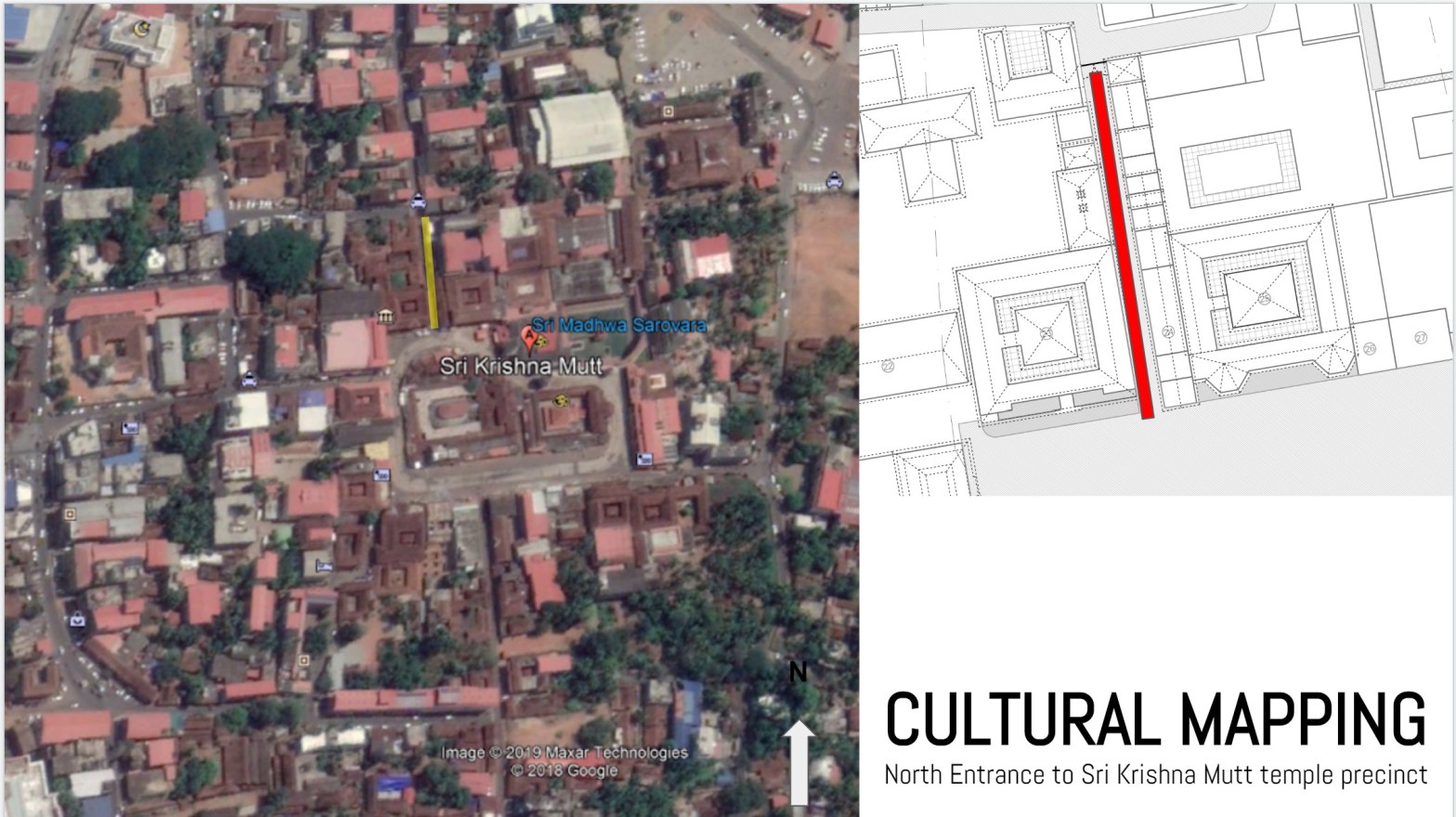
The area of analysis was the street between Car Street and Northside entrance in Sri Krishna Mutt precinct

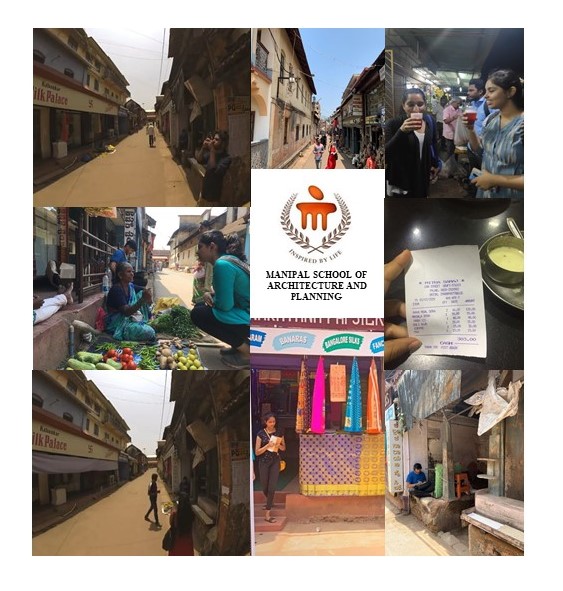
We the fourth year students of Architecture from Manipal School of Architecture and Planning, Nymisha, Anvita, Stuthi, Charan, Thomas and Abhishek, as part of our elective, conservation studies are trying to document and analyze the North street leading into the Krishna Mutt complex. By the guidance of our mentor Ar Sarmistha Chatterjee we were able to breakdown the aspects of the street and were able to understand how to be sensitive with the street. She was able to make us respect our work and every aspect that it concerns and hence were able to complete the documentation with a happy and content heart. We asked ourselves questions like – What about the street gives it such a unique character? What makes the locals frequent the street? What attracts visitors to walk through that street to enter the temple complex? Why do pedestrians take a moment to pause at certain spots. What distinguishes this street from the new ones. What aspect of the street brings in comfort to the passer by and the shop owners? These led us on in our analysis

“you don’t take a photograph, you make it.” by Ansel Adams

“According to legend, the moon’s light was once reduced due to a curse by King Daksha, whose 27 daughters (the 27 stars,according to Hindu astrology) were married to the moon. The moon prayed to Lord Shiva to get back its original shine. Lord Shiva was pleased with the moon’s prayer and restored its shine. Legend says that the moon and his wives made their prayer at the Chandramouleeshwara temple at Udupi, creating a linga that can be seen even today. According to this story, therefore, Udupi means the land of the “lord of the stars,” the moon.”
Many such tales describe the city of Udupi. It talks about the city’s cultural significance, rich heritage that has been passed down through generations etc. all these make the people of Udupi of what they are today. One such place that holds such an importance to the city is the Krishna Mutt complex. Thousands of pious devotees visit the Udupi Krishna temple all round the year to catch a glimpse of Lord Krishna. But that’s not all, what fascinates them more are the streets that surround the temple complex.

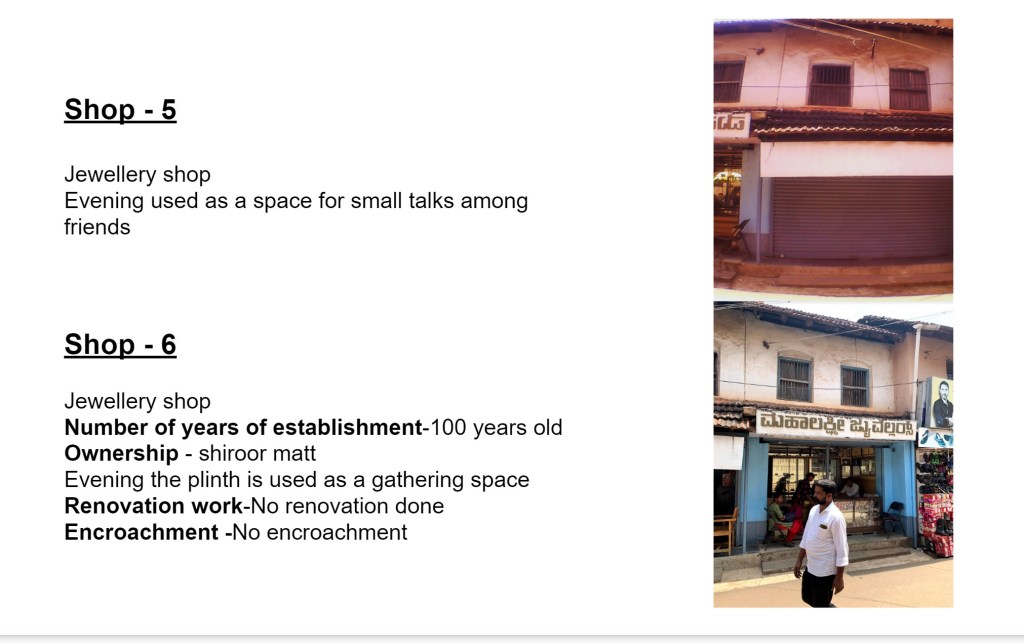
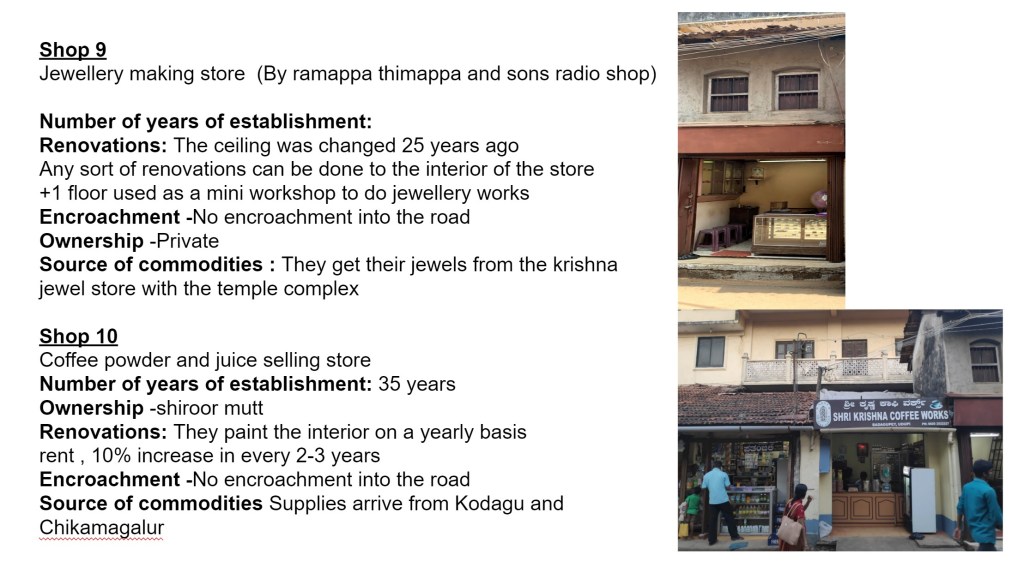
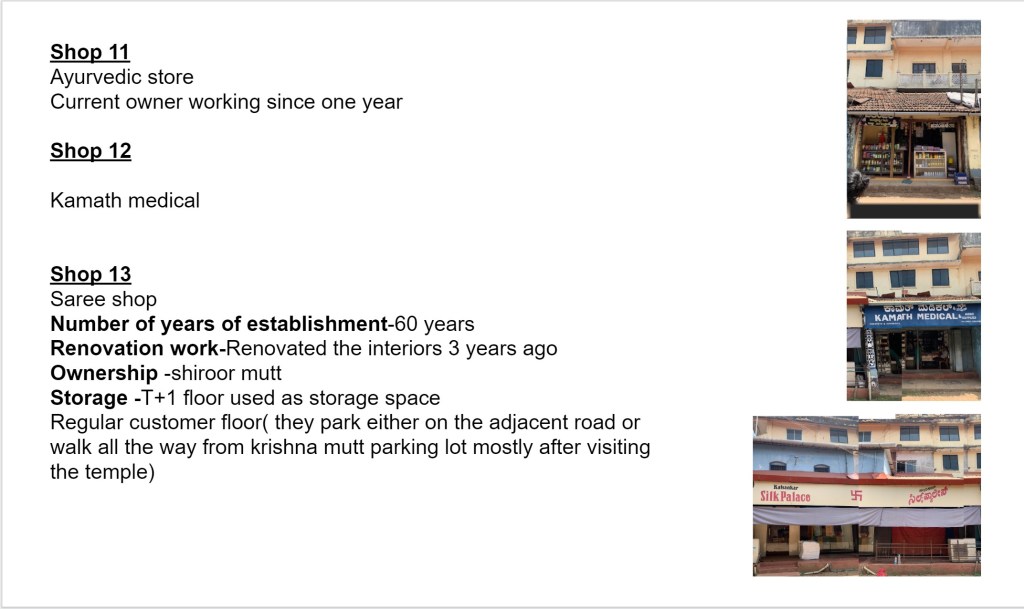
Topological Mapping of the shops

The first impression while visiting the street was ‘ Why is the street so old-looking?’ ‘What can possibly be so difficult to understand from a short stretch such as this?’ ‘ The street gives a religious vibe!’  from questions to finding answers to minor arguments and opinions we finally were able to feel the integrity and complexity of the street.

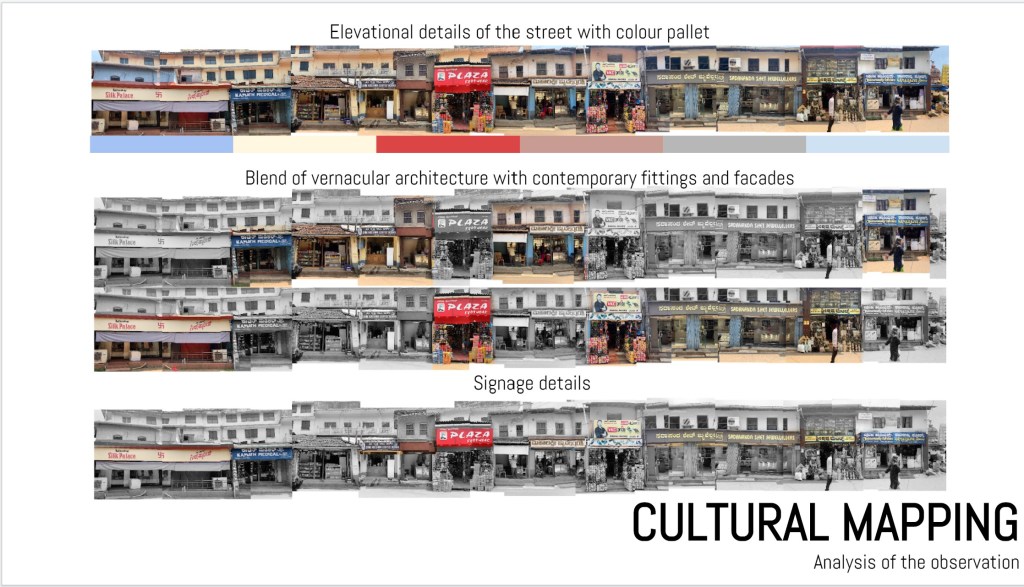
Elevation Analysis – East side
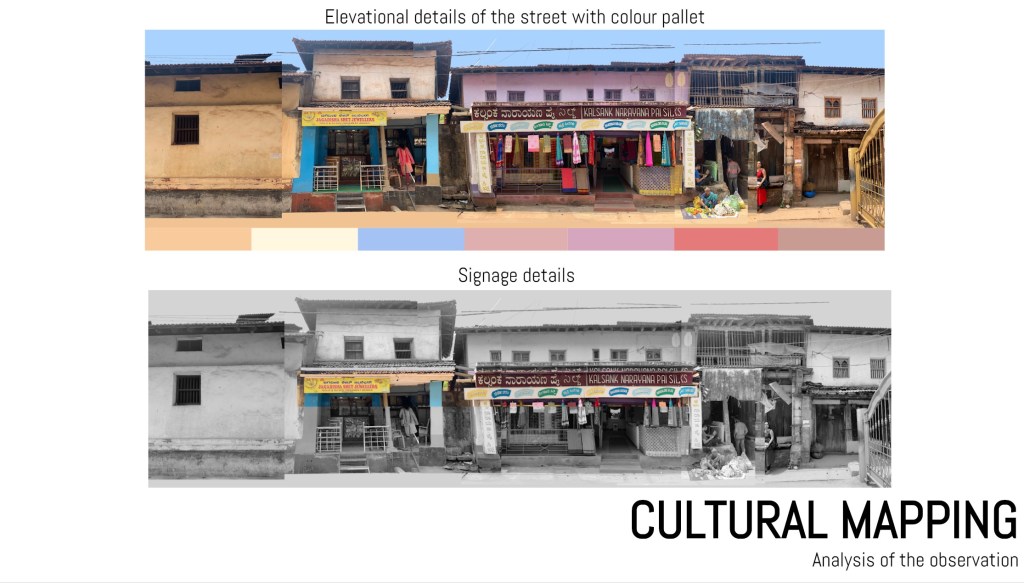
Elevation Analysis – West Side

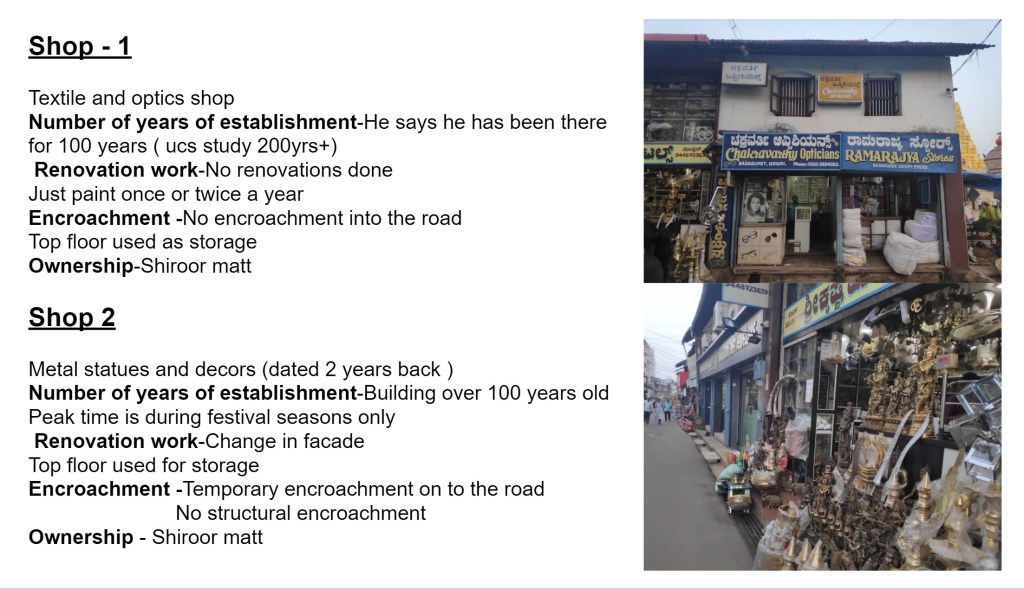
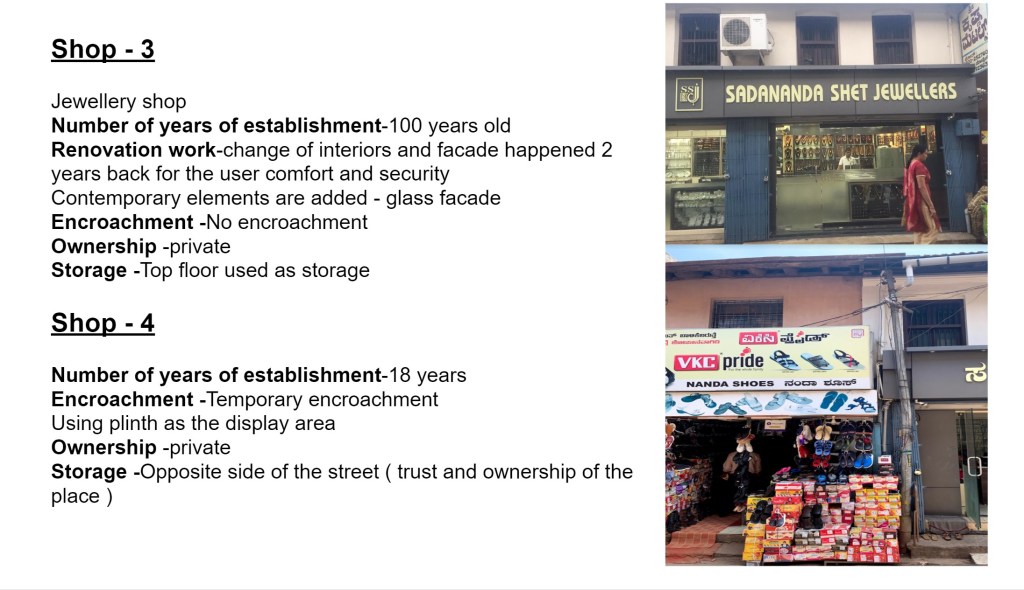
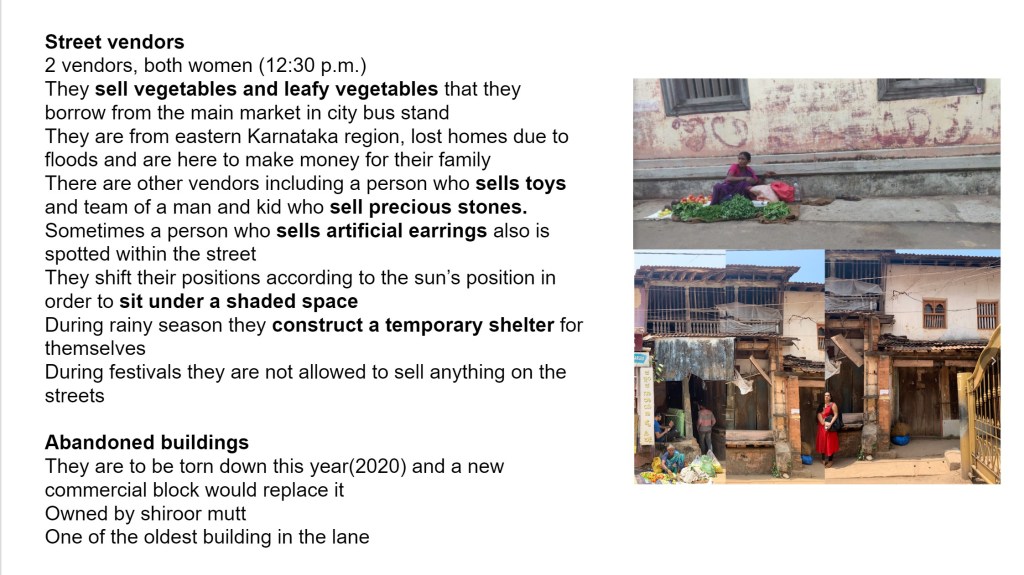
In conservation, assumption is a crime! Authenticity is the key. Therefore to understand better about the place and street and it’s nature, we interviewed all the shop owners and vendors about their experience with the street and the temple complex. Our group was lucky to have three people who speak the local language therefore it was quite easy to make them talk to us about themselves. This shows how much one’s mother-tongue  makes one so much more comfortable even if he does not know the person who he/she is talking to. 

From a person whose family sold cotton textiles for more than 100 years to a person who came to the street a year ago have so much good to talk about of the street that it makes all of us feel so happy. Hanumakka a vendor who sells vegetables was very pleased to have a conversation about her daily routine of selling vegetables and also how she changes her locations within the street according to wherever she finds shade.

  • The lane is known for its textile for more than 80 years
  • Height restrictions cannot go beyond the existing building structure
  • Temporary Front encroachments is possible as long as no one objects)
INTERVIEWS
INTERVIEWS
INTERVIEWS
INTERVIEWS
INTERVIEWS
INTERVIEWS

Introduce Yourself (Example Post)

This is an example post, originally published as part of Blogging University. Enroll in one of our ten programs, and start your blog right.

You’re going to publish a post today. Don’t worry about how your blog looks. Don’t worry if you haven’t given it a name yet, or you’re feeling overwhelmed. Just click the “New Post” button, and tell us why you’re here.

Why do this?

  • Because it gives new readers context. What are you about? Why should they read your blog?
  • Because it will help you focus you own ideas about your blog and what you’d like to do with it.

The post can be short or long, a personal intro to your life or a bloggy mission statement, a manifesto for the future or a simple outline of your the types of things you hope to publish.

To help you get started, here are a few questions:

  • Why are you blogging publicly, rather than keeping a personal journal?
  • What topics do you think you’ll write about?
  • Who would you love to connect with via your blog?
  • If you blog successfully throughout the next year, what would you hope to have accomplished?

You’re not locked into any of this; one of the wonderful things about blogs is how they constantly evolve as we learn, grow, and interact with one another — but it’s good to know where and why you started, and articulating your goals may just give you a few other post ideas.

Can’t think how to get started? Just write the first thing that pops into your head. Anne Lamott, author of a book on writing we love, says that you need to give yourself permission to write a “crappy first draft”. Anne makes a great point — just start writing, and worry about editing it later.

When you’re ready to publish, give your post three to five tags that describe your blog’s focus — writing, photography, fiction, parenting, food, cars, movies, sports, whatever. These tags will help others who care about your topics find you in the Reader. Make sure one of the tags is “zerotohero,” so other new bloggers can find you, too.

Create your own website, free on WordPress.com.Create your own website.
Start free